Understanding Environmental Product Declaration's (EPDs)
Why local data matters for New Zealand building projects
When it comes to understanding the true environmental impact of building materials, not all EPDs are created equal. Although EPDs follow strict international standards, the quality and relevance of the underlying data can vary widely, especially when generic international data is applied to New Zealand conditions.
For APL, sustainability is one of the core pillars of our business. We believe that transparency and accountability are essential to building better homes and better futures. That’s why our EPDs capture detailed, New Zealand-specific information across every part of our vertically integrated supply chain. This helps architects, builders, and homeowners make confident, informed decisions backed by accurate, independently verified data.
See more information below on what an EPD is, how APL creates one, and why choosing locally produced products with robust EPDs ensures meaningful, reliable insight into environmental impact.
What is an EPD?
An EPD is essentially a “nutrition label” for a product’s environmental footprint. It provides clear, verified data on energy use, greenhouse gas emissions, waste generation, material and resource consumption, transport and end-of-life impacts.
All EPDs follow international standards, including ISO 14025 and EN 15804, ensuring that information is consistent and comparable across similar product types. An EPD doesn’t rank a product’s environmental impact; it reports the data accurately and transparently so specifiers and consumers can make informed choices.
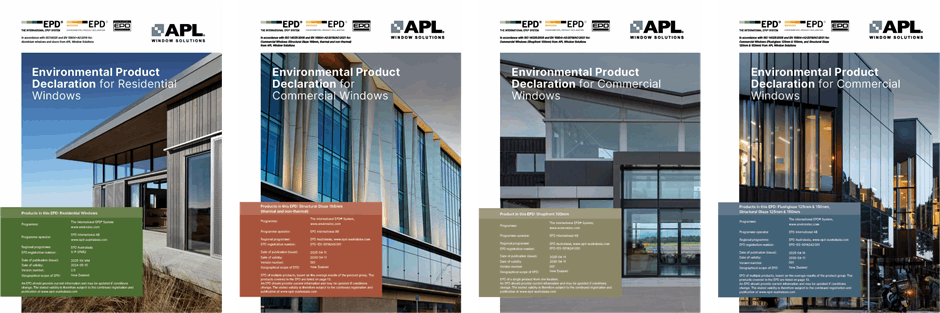
APL have four EPDs across Commercial and Residential ranges, find them linked here.
What’s included in our EPD?
Because APL operates within Profile Group, a vertically integrated group of companies, our EPDs capture a full and accurate picture of the environmental impacts behind each window and door system. This includes contributions from:
-
INEX — aluminium extrusion
-
AGP — glass manufacturing
-
Finex & ColourWorks — surface finishing
-
APL Manufacturing — hardware and components
-
PPL Plastic Solutions — seals and plastic components
-
APL Direct — national transportation network
-
End-of-Life processes — recycling, disposal, and material recovery
Why local data makes a difference
International EPDs often rely on generic global datasets and may not reflect New Zealand’s energy mix, transport distances, labour practices or end-of-life outcomes. This can significantly understate or misrepresent the environmental impact of imported products used in NZ projects.

Choosing the right product
EPD Australasia’s thorough methodology means every Environmental Product Declaration covers all relevant life cycle stages, from raw materials and manufacturing through to disposal.
While the use phase isn’t included for windows and doors (as their operational impacts are minimal and largely user-controlled), an EPD still provides a comprehensive assessment of the product's footprint.
For New Zealand building projects, transparent, NZ-specific EPDs are essential. They ensure that all contributions to carbon impact - including international shipping emissions for imported goods - are appropriately accounted for. By choosing locally made products with a robust, independently verified EPD, you’re choosing clarity, accuracy, and responsibility across the entire supply chain.
Specify with confidence
APL Ranges have four Environmental Product Declarations, view and download them here.
More stories
Reinventing the packaging wheel
There’s no denying the amount of waste being produced is concerning, it’s time to take action.
Soft plastic recycling
Continuing our journey to circularity through our partnership with PACT Recycling, the largest recycler of post-industrial plastic in the Southern Hemisphere.
See more
An aligned future with Toitū
Independent assessments and accreditations are crucial and that’s why we’re working closely with Toitū Envirocare, one of the country’s leading carbon certification organisations.
Working towards a circular economy
They say you can’t manage what you don’t measure, and that’s why a partnership was established with environmental consultancy Circularity to explore the impacts of all their waste streams.
The waste process
While APL is working hard to build a more circular business, not every material is able to be repurposed. That’s why we’re working closely with Enviro NZ, a materials management and resource recovery company.
Diversion from landfill
By collecting food scraps, we're helping power local homes and protect the environment.
The importance of ThermalHeart+®
While reducing the environmental impact of construction is a major focus of the building industry, another big focus is on reducing the amount of energy that’s required to run those buildings when they’re completed.
Environmental Product Declaration
A number of APL’s Residential and Commercial ranges have been the subject of an independent environmental and life cycle assessment by external consultants.
Biodiversity Initiative a New Zealand First
Profile Group, parent company to APL Window Solutions, has become the first participant in a new biodiversity market, purchasing biodiversity units from Sanctuary Mountain Maungatautari, in the South Waikato.
Going Electricity-Neutral
The parent company to APL Window Solutions, Profile Group, has acquired renewable energy certificates from Kawatiri Energy.
The power of the ocean
At APL, we understand the power of the ocean, and what it means to our fellow New Zealanders. We play in it. We eat from it. We live by it. It connects us all.
Homes of the future
A major sustainability project by Kāinga Ora, the government’s public housing agency, will use a new, thermally efficient product range from APL Window Solutions.
Closing the loop on waste
We’ve introduced a series of day-to-day sustainability initiatives aimed at circulating high value materials, innovating new solutions and designing out waste and emissions across the business.
Hautapu ~ Our Green building
We planned carefully to make our large, new manufacturing facility at Hautapu an example of ‘best practice’ sustainable design and construction.
Upgrading for the environment
In 2016 APL upgraded it's powdercoating lines to achieve an environmentally-friendly standard.